
EU Withdrawal Button from 19 June 2026: What You Need to Know
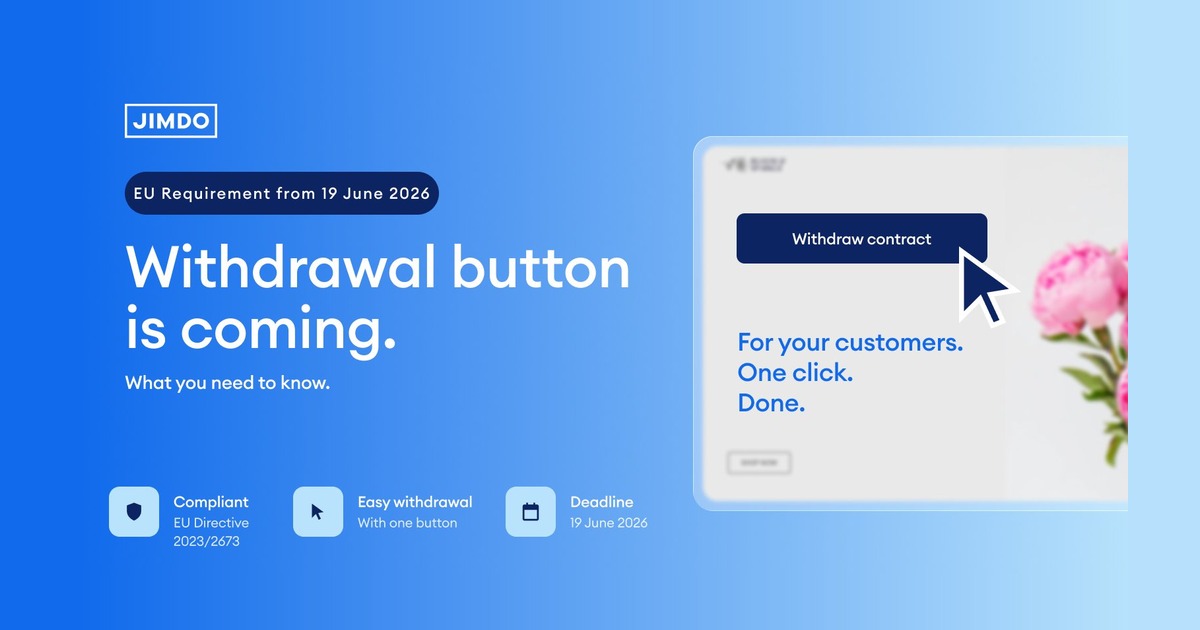


For Jimdo customers: the withdrawal button is now live in the footer of your website, fully compliant and at no extra cost.
You run a coaching business, sell products online, or take bookings through your website — and you think the new EU withdrawal button rule only affects big e-commerce players? You’d want to keep reading. The new withdrawal button requirement applies just as much to solopreneurs and small service providers as it does to large online shops. And many small business owners are underestimating just how broadly the rule applies.
In short: From 19 June 2026, any business that concludes contracts with EU consumers through a website must offer a digital withdrawal button — regardless of whether you sell goods, services, or digital products. The rule is based on EU Directive 2023/2673 (amending the Consumer Rights Directive 2011/83/EU), which is being implemented in all EU member states. What matters is where you sell your products: if you serve EU consumers, the right of withdrawal applies, and so does the button requirement.
This article explains what the withdrawal button is, whether you’re affected as a service provider, coach, or online shop owner, and what you need to do before June 2026. And if your website runs on Jimdo: the withdrawal button is now live in the footer of your website. More on that below.
What exactly is the withdrawal button?
The withdrawal button is a legally required digital function on your website. With one click, consumers will be able to cancel contracts they concluded online just as easily as they entered into them — no email form, no PDF printout, no letter by post. The logic mirrors the familiar order button: what can be done with a click should be undoable with a click.
The legal basis is EU Directive 2023/2673, which adds Article 11a to the Consumer Rights Directive. Each EU member state is implementing it into national law — in Germany through § 356a BGB, in Austria through equivalent consumer protection legislation, and similarly in all other member states. The rule takes effect uniformly across the EU on 19 June 2026. The goal: more transparency and an easier path to withdrawal for consumers.
Note for non-EU businesses: The directive doesn’t apply directly outside the EU (UK, Switzerland, US, etc.). But as soon as you actively target EU consumers, you’re affected regardless of where your business is based. If you ship to EU addresses, accept bookings from EU clients, or advertise in EU markets, the rule applies.
A quick terminology note: “button” is the common term, but the legal text actually refers to a “withdrawal function.” Some retailers also call it a “cancellation button” — though strictly speaking, cancellation and withdrawal are legally distinct (more on that below). In practice, the function can be a clearly labeled button or a visually prominent link, as long as it’s equally easy to find.
Who does this apply to — even if you don’t run an online shop?
This is the point most people get wrong. The EU withdrawal button requirement isn’t just for classic e-commerce shops shipping physical goods. It applies to any business concluding contracts with consumers through an online interface — provided a statutory right of withdrawal exists.
Concretely: you’re likely affected if you fall into any of the following groups.
Service providers with online bookings
This surprises many: Are you a coach, consultant, therapist, photographer, yoga instructor, or beauty professional who accepts bookings via your website? Then you’re concluding contracts with consumers through an online interface. The withdrawal button rule applies to you — regardless of whether you run a classic online shop or just have a booking system embedded.
Practical example: A wedding photographer selling a €2,500 photography package through their website. A yoga instructor selling 10-class passes online. A therapist offering sessions through a booking platform. All three will need a functional withdrawal function on their site from June 2026.
Online shops and product sellers
The classic case. Do you sell physical goods through your website — handcrafted products, art, books, coffee, clothing? You’re affected. This also applies if you additionally sell via platforms like Etsy, eBay, or Amazon.
Providers of digital products and courses
Do you sell online courses, e-books, templates, coaching programs, or subscriptions? The right of withdrawal applies here too, provided no statutory exemption kicks in. Course creators and digital service providers often miss this.
Who is not affected?
B2B-only businesses are exempt — contracts concluded exclusively with other businesses fall outside the rule. Pure information websites without contract conclusion aren’t affected either. And there are statutory exemptions to the right of withdrawal (for example, custom-made products or perishable goods, or digital content that has already been fully delivered with the consumer’s prior consent). But: as soon as you sell anything online that falls under the right of withdrawal, you need the button.
Important: There’s no exemption for small businesses or solo entrepreneurs. The rule applies regardless of turnover or team size.
How the withdrawal button must look and work
A few randomly placed words in the footer won’t cut it. The law sets clear requirements.
Visible and always accessible. The button must be easy to find from every subpage throughout the entire 14-day withdrawal period. Placement in the footer is allowed — but an unobtrusive text link explicitly doesn’t meet the requirement. It must be visually prominent.
Clearly labeled. The label must unambiguously indicate that a contract can be withdrawn here. “Withdraw from contract” works. “More info” or “Contact” don’t.
Two-click principle. Withdrawal happens in two steps: first the customer clicks the button, then they enter a few basic details (for example order number and email address) and confirm the withdrawal via a second button. Only then is the withdrawal legally valid.
Confirmation of receipt. After the withdrawal, your customer must receive electronic confirmation of receipt without delay, including the content of the withdrawal and the date and time received.
GDPR-compliant. You may only collect data that’s genuinely necessary for processing the withdrawal. You can ask for a reason for withdrawal, but only as an optional field — making it mandatory isn’t allowed. And you can’t generally hide the button behind a login — unless the contract itself requires a customer account.
Withdrawal button vs. cancellation button
A common confusion. Some countries (like Germany since July 2022) already require a cancellation button for subscriptions or ongoing contracts. That does not replace the withdrawal button. The two functions serve different purposes and must be clearly separated.
The cancellation button ends an ongoing contractual relationship for the future — think fitness subscription or course membership.
The withdrawal button reverses a contract concluded online entirely — all services already provided must be returned or refunded.
Both can and must coexist if you offer both one-off contracts and subscriptions.
What happens if you don’t comply?
The consequences are concrete and expensive:
- Warnings from competitors or consumer protection associations. Faulty or missing withdrawal rights are among the most common grounds for cease-and-desist notices in e-commerce.
- Fines for violations (in Germany up to €50,000; in some member states up to 4% of annual turnover for companies with a union-wide turnover above €1.25 million).
- Extended withdrawal periods. If the button is missing or doesn’t work properly, your customers’ withdrawal period automatically extends — in the worst case to up to 12 months and 14 days. That means: bookings you thought were long settled can still be cancelled nearly a year later.
- Loss of trust. An opaque withdrawal process comes across as unprofessional — and is increasingly rated negatively by platforms and review sites.
How to prepare as a Jimdo customer
If your website runs on Jimdo, here’s the most important thing to know: The withdrawal button is now live in the footer of your website, fully compliant and at no extra cost.
This is part of a broader principle for us: as an AI-powered growth platform for solopreneurs and small businesses, we want you to focus on your business — not on technically implementing EU directives yourself. Legal compliance, GDPR, automated legal texts: all of this runs in the background at Jimdo.
This applies to all Jimdo websites where customers can directly purchase or book — meaning websites with an online store or Jimdo Bookings. If your website has no shop or booking functionality, or if you sell exclusively to business customers (B2B), nothing changes for you.
What you need to do right now: check whether the button applies to you. For EU websites, Jimdo has already activated it automatically. If you’re running a non-EU website but sell to customers in the EU, you can turn it on anytime in your settings.
What’s happening on the legal side. Your withdrawal instructions will also need to reference the new digital withdrawal function. If you have the Jimdo Legal Text Manager activated, your withdrawal instructions will be updated automatically — including warning protection via Trusted Shops. You won’t need to handle wording or legal updates yourself.
Without the Legal Text Manager activated, Jimdo provides templates, but legal accuracy is your own responsibility. We strongly recommend activating the Legal Text Manager — especially for legal changes like this, it saves a lot of work and reduces your exposure to warnings.
Where Jimdo reaches its limits. For edge cases — custom service contracts, complex B2B/B2C mixed models, or particular exemptions from the right of withdrawal — even the best legal text manager can’t replace individual legal advice. If you’re unsure about your specific case, check with a lawyer specializing in IT or consumer law.
Your 5-step withdrawal button checklist
- Check whether you’re affected. Do you conclude contracts with consumers through your website? Then probably yes.
- Update your withdrawal instructions. They need to reference the new button. Jimdo users with the Legal Text Manager get this automatically.
- Plan the technical implementation. Check what solution your website provider offers. With Jimdo, the withdrawal button has already been automatically activated for EU websites.
- Test the withdrawal process. Click through it yourself: Can you find the button? Does confirmation work? Does the email arrive?
- Define your internal processes. Who handles incoming withdrawals? How do you document them? How do refunds work?
With Jimdo, the technical framework is already in place. Activate the Legal Text Manager and the legal side is covered too.
FAQ
When does the withdrawal button requirement take effect?
From 19 June 2026 across the EU. The basis is EU Directive 2023/2673, which amends the Consumer Rights Directive and is being implemented into national law in Germany (§ 356a BGB), Austria, and all other EU member states. The date is binding — no transition period. What matters is where you sell: if you serve EU consumers, the requirement applies to you, regardless of where your business is based.
Do solopreneurs and service providers also need a withdrawal button?
Yes. The rule applies to all contracts concluded with consumers through an online interface where a statutory right of withdrawal exists. That includes coaching, consulting, photography packages, courses, and almost all digitally bookable services — whether you run a classic online shop or just use a booking system.
Does the rule apply to B2B businesses?
No. If you exclusively contract with other businesses, you’re not affected. For mixed models (B2B and B2C), the rule kicks in as soon as consumers can also purchase from you.
What are the penalties for non-compliance?
Warnings from competitors or consumer protection associations, fines (in Germany up to €50,000; in some member states up to 4% of annual turnover for larger companies), and an automatic extension of the withdrawal period to up to 12 months and 14 days. The last one is the biggest risk for many small businesses — bookings can be cancelled nearly a year after delivery.
Does the button need to be visible everywhere on my site?
It must be easily accessible from every subpage. In practice this is usually solved via a prominent link in the footer. Important: an unobtrusive text link explicitly isn’t enough, according to the legislative reasoning.
What’s the difference between the withdrawal button and a cancellation button?
They serve different legal purposes. A cancellation button ends an ongoing contract for the future (like a subscription). A withdrawal button reverses a contract entirely — all services provided must be returned or refunded. Both can coexist on the same site and don’t replace each other.
Does Jimdo update my withdrawal instructions automatically?
If you have the Jimdo Legal Text Manager activated: yes. Your withdrawal instructions will be automatically adapted to the new legal situation — including warning protection via Trusted Shops. Without the Legal Text Manager activated, we provide templates, but legal accuracy is your own responsibility. For edge cases or complex contract models, we also recommend individual legal review.
Do I need to build a withdrawal button myself as a Jimdo customer?
For EU websites, Jimdo has already automatically activated the withdrawal button in the footer of your website, fully compliant and at no extra cost. If it doesn’t apply to you, you can turn it off anytime in your settings.
Conclusion
The EU withdrawal button has been a legal requirement since 19 June 2026, and it affects significantly more small businesses than most realize.
The good news for Jimdo customers: the withdrawal button is now live in the footer of your website, fully compliant and at no extra cost. If it doesn’t apply to you, you can turn it off anytime in your settings.
Note: This article does not replace individual legal advice. For complex contract models or uncertainties, please consult a lawyer specializing in IT or consumer law.
Build a strong business with Jimdo.
Create a website and get found, get booked, get paid – all in one place.

🚀 Ready to take your business online?
No credit card needed. Online in minutes.