
E-Invoicing in Germany: What’s Coming for the Self-Employed in 2027 and 2028
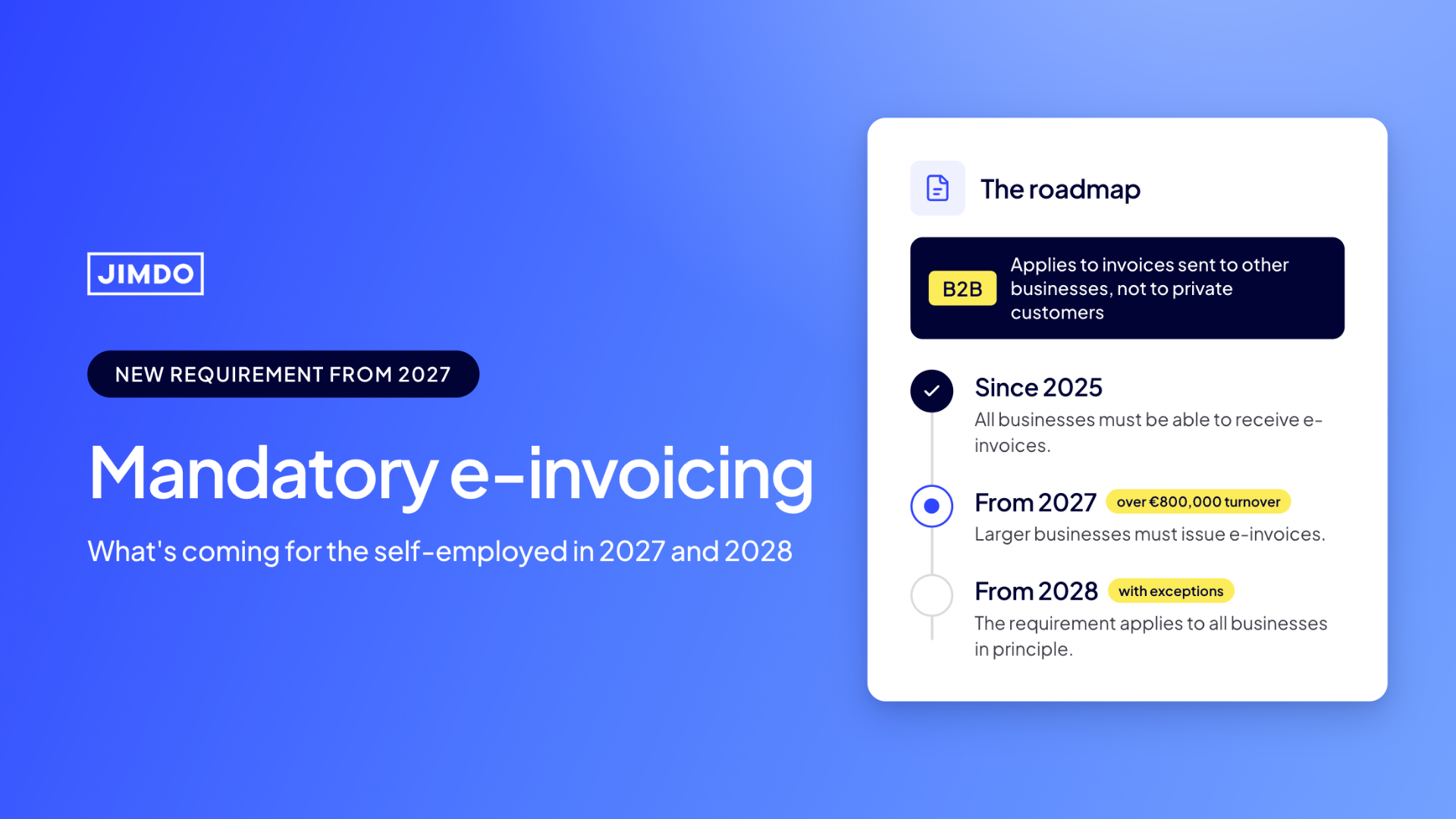


E-invoicing in Germany stopped being a future topic a while ago. The switch has been underway since 2025, and over the next two years it becomes mandatory for almost everyone. Even so, few topics raise as many question marks: Do I even have to as a small-business owner? Doesn’t my PDF already count as an e-invoice? And when does it get serious?
The key facts at a glance
- Since January 1, 2025, every domestic business has to be able to receive and process e-invoices, small-business owners included.
- The obligation to issue them comes in stages: from January 1, 2027 for businesses with over 800,000 euros in prior-year turnover, from January 1, 2028 for everyone.
- Until then you may still send paper or PDF invoices with the recipient’s consent, and smaller businesses even until the end of 2027.
- Only domestic business-to-business (B2B) transactions are affected. Invoices to private customers (consumers) are not.
- An e-invoice is a structured data record following the EN 16931 standard, for example XRechnung or ZUGFeRD. A normal PDF does not count.
- Small-business owners under the §19 UStG scheme are permanently exempt from issuing, but still have to be able to receive e-invoices.
- The legal basis is the Growth Opportunities Act (Wachstumschancengesetz); the implementation details are set out in a letter from the Federal Ministry of Finance (BMF).
What is an e-invoice, exactly?
An e-invoice isn’t simply an invoice as a file or PDF. It’s a structured data record that software can read automatically. It follows the European standard EN 16931 and is defined that way in the VAT Act (§ 14 UStG).
Is a PDF invoice sent by email already an e-invoice?
No. Sending an invoice digitally isn’t the same as issuing an e-invoice. The difference isn’t the delivery route, it’s the format.
A PDF is made for the human eye, whether you print it or send it by email. An e-invoice is a structured data record that software can read automatically. That’s why a PDF remains, legally, an “other invoice,” even when it reaches your customers digitally.
When does the e-invoicing obligation apply?
The obligation arrives in phases, and it’s worth separating receiving from issuing.

Do I have to as a small-business owner too?
Partly yes, partly no. Small-business owners under the §19 UStG scheme are permanently exempt from issuing e-invoices. So even after 2028 you don’t have to write an XRechnung if you fall under the small-business scheme.
But you do have to be able to receive them. That obligation has applied to everyone since 2025, you included. You have to be able to accept, read and store e-invoices.
Does this affect me if I only sell to private customers?
No. The e-invoicing obligation applies only to transactions between domestic businesses (B2B). Invoices to private customers (B2C) are not affected.
Purely foreign transactions are also out of scope for now. Cross-border trade is covered by a separate EU initiative called ViDA (VAT in the Digital Age), which arrives on its own timeline.
What does the duty to receive mean for me in practice since 2025?
You have to be technically able to accept an e-invoice. For receiving alone, an email inbox is enough, because the file often simply arrives by email.
Processing involves more: you need a way to display the structured data record in readable form, and you have to archive the invoice in a GoBD-compliant way. So it’s worth looking at your invoicing or accounting tool now, not only in 2028. With Jimdo’s invoicing tool, for example, you create your invoices automatically with all the mandatory details and as an e-invoice.
Which formats are allowed?
Anything that meets the EN 16931 standard. In practice that mainly means two formats: XRechnung and ZUGFeRD.
XRechnung is a pure data record. ZUGFeRD is a hybrid, a PDF with an embedded data record that’s readable by humans and machines at the same time. Both meet the requirements, you just have to pick one.
Can I create an e-invoice without software?
In theory yes, in practice hardly. An e-invoice is a structured data record. You’d have to write the code by hand and hit the EN 16931 standard exactly. That’s error-prone and not a realistic option for most people.
The good news: you don’t need an expensive extra program for it. With Jimdo’s invoicing tool, for example, you create your invoices automatically with all the mandatory details, legally compliant and e-invoice-ready, without dealing with formats yourself. A normal Word document or PDF, on the other hand, isn’t enough, because the structured data record is missing.
Are there exceptions?
Yes, a few. Regardless of any deadlines, these stay permanently exempt:
- Small-value invoices up to 250 euros gross
- Transport tickets that count as an invoice
- Invoices to private customers (B2C)
- Services from small-business owners under the §19 UStG scheme (for issuing only)
In these cases you may keep using paper or PDF.
What happens if I ignore the obligation?
Once you’re required to issue e-invoices and still send only a PDF, your invoice formally doesn’t count as a correct invoice. That can cause trouble, above all for your business customers, whose input VAT deduction can start to wobble as a result.
In short: you risk follow-up questions, rework and unhappy customers. Tackle the switch early and you spare yourself that stress.
What should you do now?
No need to panic, but a good moment to prepare. These three steps help:
- Check whether you can receive, display and archive e-invoices in a GoBD-compliant way. This already applies today.
- Find out from when you’ll have to issue them yourself. That depends on your turnover and your legal form.
- Look at a tool that supports XRechnung or ZUGFeRD in good time, so you’re not scrambling in 2027 or 2028.
How Jimdo helps you with the e-invoicing obligation
If you write your invoices with Jimdo, it takes the worry about formats and mandatory details off your plate entirely. All mandatory details are included automatically, every invoice is legally compliant and e-invoice-ready. Add your logo and your own invoice numbers, and export any invoice as a PDF for your tax advisor or bookkeeping whenever you need to.
The rest runs in the same flow: every booking and every order feeds automatically into your invoice, including customer data and a payment link. Your customers pay in one click, via Visa, Mastercard, Apple Pay, Google Pay, SEPA and more, shared by WhatsApp, email, DM or QR code. And follow-ups happen now too, if an invoice isn’t paid on time.
You can read how this works in detail here: Invoicing and payments with Jimdo.
Please note
This article gives a general overview and does not replace tax or legal advice. Whether, from when and in what form the e-invoicing obligation applies to you depends on your turnover, your legal form and your tax situation. When in doubt, clarify it with your tax advisor.
Build a strong business with Jimdo.
Create a website and get found, get booked, get paid – all in one place.

🚀 Ready to take your business online?
No credit card needed. Online in minutes.