
The EU Packaging and Packaging Waste Regulation (PPWR): What the Self-Employed and Small Businesses Need to Know


Since 12 August 2026, the new EU Packaging and Packaging Waste Regulation, the PPWR for short, has been in effect. Many people read about it and immediately picture large corporations with their own production lines. But the rules apply just as much to the small online shop that ships jam, candles or jewellery.
The good news: you probably know a lot of it already, and most of it is manageable. Here’s the overview, clear and without the legal jargon.
The key facts at a glance
- The EU Packaging and Packaging Waste Regulation (PPWR), Regulation (EU) 2025/40, has applied directly across the EU since 12 August 2026 and replaces the old Packaging Directive from 1994.
- It affects whoever first places packaging on the market. The PPWR redefines this role, with an important relief for many online sellers.
- If you use standard shipping packaging from a German supplier for domestic shipping only, your supplier takes on the duties. For custom, imported or cross-border packaging, you stay responsible.
- If you sell into other EU countries, you may need a separate registration and an authorized representative in each target country. This point is especially contested right now.
- Where you’re responsible, there’s no minimum threshold: small businesses are included too, regardless of volume.
- In Germany you already know the basics: registration with LUCID plus licensing with a dual system. That stays in place.
- New from August 2026: substance limits, a declaration of conformity and harmonized labeling, among others. More requirements follow up to 2030 and beyond.
- Pure service providers with no physical products or shipping are usually not affected.
What is the EU Packaging and Packaging Waste Regulation (PPWR)?
PPWR stands for Packaging and Packaging Waste Regulation. It aims to cut packaging waste, improve recycling and create uniform rules across the whole EU market.
One point that often gets confused: it’s a regulation, not a directive anymore. Many people still say “Packaging Directive”, but the old directive from 1994 has now been replaced. A regulation applies directly in every member state, without a country having to turn it into national law first.
In Germany, the previous Packaging Act (VerpackG) is largely replaced on 12 August 2026 by the Packaging Enforcement Act (VerpackDG), which links German law with the PPWR.
Does the PPWR affect me as a self-employed person or small business?
That depends on which packaging you place on the market, and how. In principle, whoever first makes a packaging available in an EU country is responsible. But the PPWR redefines this role, and that creates an important relief for many online sellers.
If you buy standard shipping packaging from a German supplier and use it only for shipping within Germany, your supplier now takes on the packaging duties, not you. You do stay responsible if:
- you use custom-made packaging or your own packaging under your brand,
- you sell across borders into other EU countries,
- or you source packaging from abroad and ship it filled to German customers.
The packaging of your own products, such as your branded jar or folding box, also usually falls to you.
Where you’re responsible, there’s no minimum threshold. You’re included regardless of volume, even as a small business. Pure service providers with no physical products or shipping, on the other hand, are usually not affected. Because the roles are redistributed under the PPWR, it’s worth a quick check to see which one applies to you.
One special case deserves your attention early: selling into other EU countries. There, you may need a separate registration and a local authorized representative in each target country. This is heavily contested right now, and some small shops are pausing cross-border EU shipping because of it. What’s happening there, and what it means for you, comes further down.
Which duties have applied in Germany for a while?
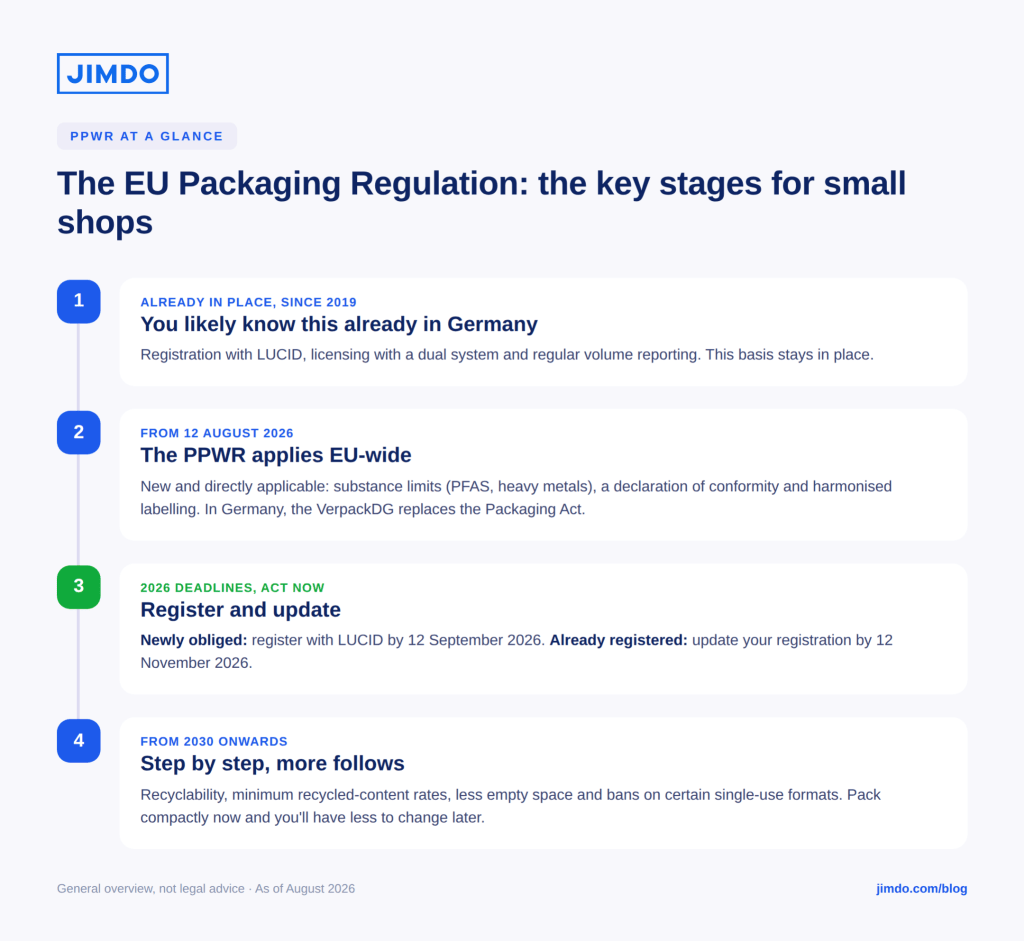
If you’re responsible for your packaging, you probably know these three steps in Germany already. They come from the Packaging Act and stay in place under the new law:
- Register. Before you ship for the first time, sign up for free in the LUCID packaging register (verpackungsregister.org). You’ll get a LUCID number.
- License. Sign a system-participation contract with a dual system, such as Landbell or Interseroh. This covers the disposal costs of your packaging and costs money depending on volume and material.
- Report. Submit your packaging volumes regularly to the dual system and the Central Agency Packaging Register.
One reason not to put it off: marketplaces like Amazon, eBay or Etsy have required proof of your LUCID registration since 2021. Without it, you can’t sell there.
What changes from 12 August 2026?
On top of these familiar steps, the PPWR brings new, directly applicable requirements. For small shops, these matter most:
- Substance limits. New limits apply to packaging, for example for PFAS in food-contact packaging and for heavy metals like lead and cadmium.
- Declaration of conformity. Packaging needs a declaration confirming that it meets the regulation’s design requirements.
- Labeling. Harmonized labels are coming to make correct disposal easier for your customers. This also includes details of the responsible parties on the packaging.
Whether the declaration of conformity and labeling apply to you directly depends on your role. If you design packaging yourself or have it made under your own brand, more falls on you. If you use off-the-shelf standard packaging, much of it sits with the packaging manufacturer.
By when do you have to register?
For the switch to the new law, Germany has clear deadlines:
- If you’re newly obliged and not yet registered, you have to sign up with LUCID by 12 September 2026.
- If you’re already registered, you have until 12 November 2026 to update your registration to the new requirements.
So if you already have a LUCID number, check your details in good time. If not, registration is the first and most important step.
What comes later, from 2030?
Not everything applies straight away. Many of the bigger design requirements are phased in up to 2030 and beyond. You don’t have to implement them yet, but it’s worth keeping them in view:
- Recyclability. Packaging should be recyclable by 2030, according to fixed criteria.
- Recycled content. Minimum rates of recycled material are coming for plastic packaging.
- Less empty space. Oversized packaging with a lot of air is being limited, especially in mail order.
- Bans and reuse. Certain single-use formats will be banned, and reuse quotas are coming for some areas.
Pack compactly and recycling-friendly today, and you’ll have less to change later.
Are there exemptions for micro-enterprises?
There’s no general exemption for small businesses. The registration duty has no minimum threshold. But there is an important relief for micro-enterprises.
If a micro-enterprise has packaging made under its own name or brand, then under certain conditions the producing company counts as the producer, not the micro-enterprise. A micro-enterprise is usually one with fewer than 10 employees and no more than 2 million euros in annual turnover. The Central Agency Packaging Register explains who counts as producer and manufacturer, especially for own brands, in detail. Whether this rule applies to you is best clarified with your legal adviser.
And honestly: we don’t think this distribution of burden is fair. Micro-enterprises can be loaded with almost the same requirements as large companies under the new EU Packaging and Packaging Waste Regulation. Especially contested is the duty to appoint an authorized representative in each target country for shipping into other EU countries, and to join the local system there. For many small shops that doesn’t pay off, and some are stopping cross-border EU shipping altogether.
The situation here is contradictory right now. The EU Commission has itself called for this authorized-representative duty to be scrapped, and recommends that authorities not penalize breaches for now, but only issue warnings. That isn’t binding, though: the EU Council halted the planned reliefs in June 2026, and Parliament is negotiating an exemption for small businesses no earlier than autumn 2026. Until then the duty still applies, and how strictly a country enforces it varies. So don’t rely on the announced leniency alone: work out soberly whether shipping into individual EU countries still pays off, and keep an eye on how this develops, because quite a bit could still change in the coming months.
What happens if you do nothing?
Then it gets expensive fast. If your LUCID registration or your dual-system licensing is missing, you risk warning letters, fines and, in the worst case, a sales ban. Marketplaces will block you without proof anyway.
The effort for the basic steps is manageable, the risk of doing nothing is not. Getting registration done early is far more relaxing than waiting for the first warning letter.
Your next steps
Work through the points in order. The first two are the most important:
- Clarify your role. If you sell physical products, check whether you’re responsible: custom, own-brand or imported packaging and sales into other EU countries are on you, plain domestic standard packaging from a German supplier is not.
- Register with LUCID, free of charge at verpackungsregister.org. Deadline: newly obliged by 12 September 2026, existing registration updated by 12 November 2026.
- Sign up for dual-system licensing and report your volumes.
- Check your packaging: substance limits, labeling, and whether it’s standard or your own packaging.
- Think ahead: pack compactly, recyclably and with as little material as possible.
And if you run your shop with Jimdo?
The selling side is covered with the Jimdo Online Store: products, orders and payment in one place. The packaging duties like LUCID and dual-system licensing you handle separately with the relevant bodies, because they attach to you as the seller, not to your shop system. Once your role is clear, though, it’s usually just a few steps. You’ll find them in the list above.

Frequently asked questions
Does the EU Packaging Regulation also affect small traders and small businesses?
Yes, as long as you’re responsible for the packaging, because then there’s no minimum threshold, even for small volumes. But the PPWR redistributes the roles: if you use standard shipping packaging from a German supplier for domestic shipping only, the duty can sit with the supplier. For custom, imported or cross-border packaging, you’re on the hook yourself.
Is the PPWR a directive or a regulation?
A regulation. The PPWR (Regulation (EU) 2025/40) replaces the old Packaging Directive from 1994. As a regulation, it has applied directly in all EU member states since 12 August 2026, without national transposition.
Do I still have to license my shipping packaging as an online seller?
That depends on your packaging. For standard shipping boxes from a German supplier that you use domestically only, the supplier now takes on the duties. You stay responsible for custom or own-brand packaging, imported packaging and cross-border sales. The packaging of your own products is usually yours too.
Does the Packaging Regulation also apply to pure service providers?
Usually not. If you sell no physical products and ship nothing, you place no packaging on the market, for example as a coach, consultant or with digital products. But as soon as goods with packaging are involved, the duty applies.
Does the EU Packaging Regulation also apply in Austria and Switzerland?
Austria yes, Switzerland not directly. Austria is an EU member, so the PPWR has applied there since 12 August 2026 just as directly as in Germany, on top of Austrian packaging law. If you sell from Germany to Austrian customers, a separate registration in Austria may be needed, because producer duties apply per country. Switzerland is not in the EU: for sales within Switzerland or shipments you send there, the PPWR does not apply. It does apply, however, when a Swiss company places packaging on the EU market, for example by shipping to customers in Germany or Austria. What matters is the market you serve, not where your business is based.
What applies if I sell via platforms like Vinted?
That depends on whether you sell privately or commercially. Purely private sales, such as occasionally getting rid of your own used clothes, are usually not covered. Then you don’t have to worry about packaging duties. But if you sell commercially, meaning regularly and with the intention of making a profit, the same rules apply as for your own shop. Then you’re responsible for your shipping packaging and need LUCID registration and dual-system licensing, with the same relief as above: for standard shipping packaging from a German supplier used domestically, the duty can sit with the supplier. Platforms like Vinted, Etsy or eBay also have to check whether commercial sellers are registered, and can otherwise bar you from selling. So what matters is whether you act commercially, not the platform itself.
Am I exempt from the PPWR as a micro-enterprise?
There’s no general exemption. But there is a relief: if a micro-enterprise has packaging made under its own name or brand, then under certain conditions the producing company can step in for the micro-enterprise. Whether that applies to you is something to have checked legally.
By when do I have to register for the new rules?
Anyone newly obliged and not yet registered has to sign up with LUCID in Germany by 12 September 2026. Anyone already registered has until 12 November 2026 to update their registration to the new requirements.
Please note
Last updated: August 2026. This article gives a general overview and does not replace legal advice. Whether and which duties apply to you depends on your role, your products and your specific situation. When in doubt, seek qualified advice. Official information is available from the German Federal Environment Ministry and the Central Agency Packaging Register.
Build a strong business with Jimdo.
Create a website and get found, get booked, get paid – all in one place.

🚀 Ready to take your business online?
No credit card needed. Online in minutes.